
Journals
-
Agora. Social Sciences Journal
Agora. Social Sciences Journal
Peer-reviewed academic periodical journal of the National University “Ostroh Academy”, which publishes the results of scientific research in the field of social sciences (primarily in the specialty – C2 Political Science). Priority is given to the publication of empirical studies that focus on the analysis of political and social processes in the countries of Central and Eastern Europe. Simultaneously, the journal accepts original results of interdisciplinary research at the intersection of political science, sociology, political geography, international relations, social communications, and regional studies. The journal serves as a platform for scholarly dialogue based on open-access principles and promotes the dissemination of high-quality research results in the social sciences.
In addition to academic articles, the journal publishes reviews of new publications in the social sciences, scholarly discussions, and reports on conferences, round tables, and other academic events that contribute to the development of professional discourse and the integration of the Ukrainian academic community into the international academic arena.
-
Scientific Notes of Ostroh Academy National University, Philosophy Series
The scientific journal "Scientific Notes of Ostroh Academy National University, Philosophy Series" is an open access scientific publication. This means that all content is freely available and free to users or their organizations. Users are permitted to read, download, copy, distribute, print, search or link to the full texts of articles in this journal without seeking permission from the publisher or author. This definition of open access is provided by BOAI (Budapest Open Access Initiative).
-

Scientific Notes of Ostroh Academy National University, Economics Series
Thematic orientation - the studies in the field of economics.
Sientific journal reveals topical issues of economic theory, national economy management, management of sectors and enterprises, labor economics and regional economy, finance, monetary circulation and credit, accounting, analysis and audit, mathematical modeling and information technologies in economics. The materials will be useful for scientists, teachers, economists-practitioners, students.
-
Scientific Notes of Ostroh Academy National University, Historical Sciences Series
The scholarly journal is dedicated to the issues of the Ukrainian and the world history, historiography, and source studies. The journal indicates the research interests of the scholars of the National University of Ostroh Academy and other scientific and educational institutions of Ukraine. This issue is devoted to the 70th anniversary of Professor Volodymyr Trofymovych.
For historians, teachers, young scholars, and students. -
Scientific Notes of Ostroh Academy National University, Psychology Series
Scientific Notes of Ostroh Academy National University, Psychology Series publishes original scientific manuscripts performed in the context of actual problems of personality psychology and related branches of psychological science in various aspects: theoretical and methodological works; works describing the results of empirical studies; works which describe new methodical (diagnostic, corrective-developing, etc.) techniques. The Journal presents the results of the theoretical and experimental developments, problems of fundamental and applied psychology. The problems of personality, cognitive sphere, issues of social, pedagogical psychology, peculiarities of behavior that do not conform to the norm, etc. are also considered. It is intended for university teachers, researchers, post-graduate students and students of psychological faculties of higher educational establishments, as well as for practicing psychologists.
-
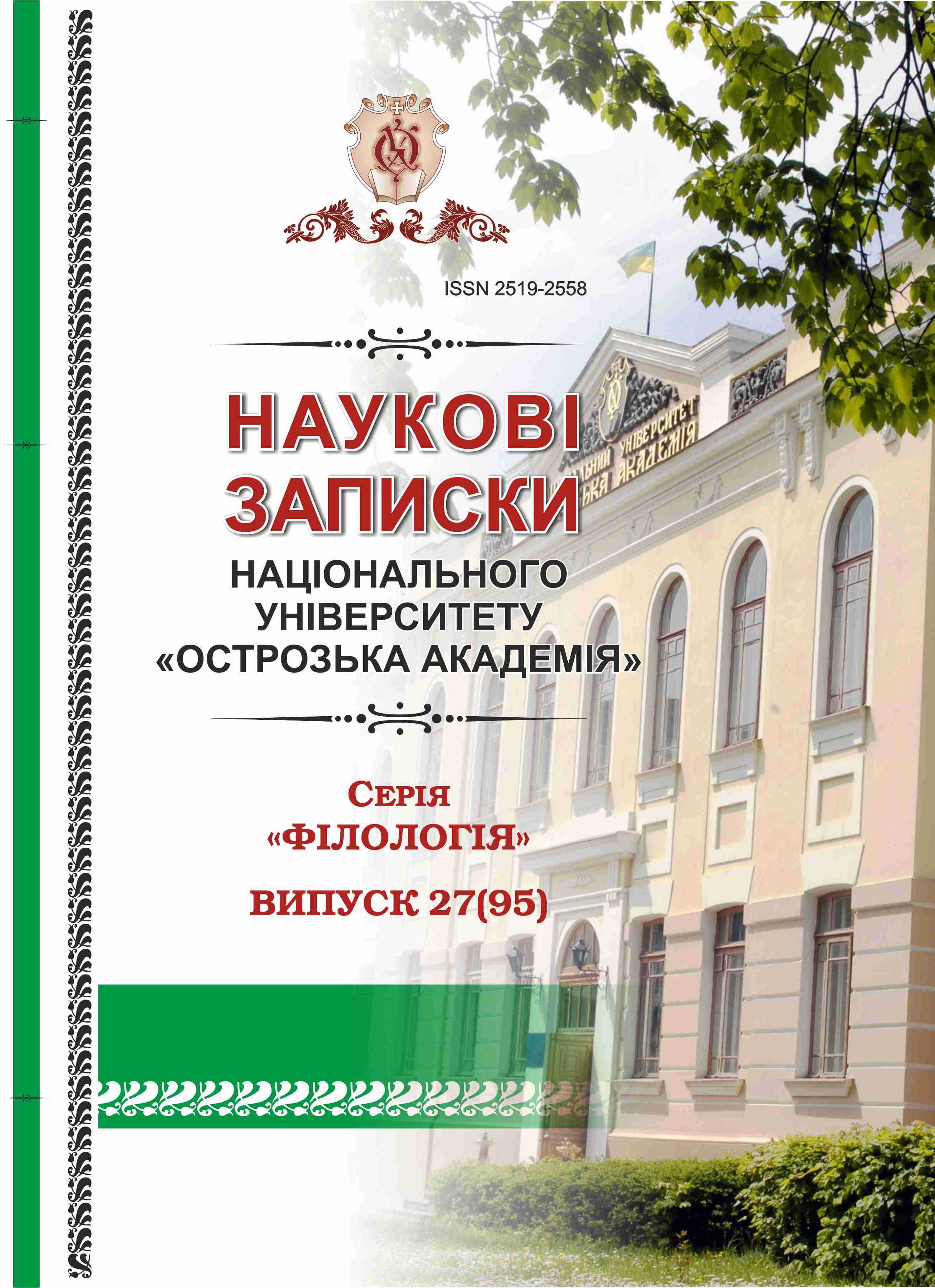
Scientific Notes of Ostroh Academy National University, Philology Series
The proceedings contain scientific articles on modern linguistics and literary studies. Recommended to philology scientists, teachers, students and those interested in language studies.
Scientific Notes of Ostroh Academy National University: Philology Series, are scientific publications for public access. This means that all content is freely available and is free of charge to users or their organizations. The users are permitted to read, download, copy, distribute, print, search, or link to the full texts of the articles in this journal without asking permission from the publisher or the author. The definition of open access is given according to BOAI (Budapest Open Access Initiative).